
국제경쟁
대상 (흰기러기상)
With or Without Me
- Vietnam
- 2011
- 80min
- DigiBeta
- Color

Synopsis
With or Without Me is an intimate, tragicomic por trayal of t wo guys struggling with drug use, and of the wives, family, doctors and friends tr ying to pull them back from the brink. T hi and Trung are t wo men that live in a mountainous Vietnamese province on the border with L aos and like many other young men who live in this province, they are both living with HI V. Thi wants life and wishes for future happiness with his wife. He is determined to overcome his addiction, though his surroundings will make this tough. But Trung is preparing for the end and reflects upon the life that might have been with his ancestors, sinking into despair he continues to use heroin to escape the realit y of his position. T his film graphically illustrates the impact of drug use and HI V upon individuals, families and communities and shows the destinies and tragedy of t wo individual lives to sheds a light upon a wider unfolding stor y about drug use in Vietnam and, in doing so, it hopes to contribute to the debate about how best to tackle this issue.
Director
-
 TRAN Phoung ThaoBorn in 1977, Vietnam. She studied foreign trade and interpretation in Hanoi, and went to France to become a professional filmmaker. She acquired her Masters in Documentary Directing at the Université de Poitiers, France in 2004. She now works along side Swann, in Hanoi, as a co - director in a variety of documentary films, including With or Without Me.
With or Without Me (2011)
Worker’s Dream (2007) -
 Swann DUBUSStudied literature and cinema and has been filming and directing documentary films since 2000. Swann has worked in both Europe, Africa and Asia. He now lives and works in Hanoi, Vietnam, alongside Thao.
With or Without Me (2011)
L. Ville (2006) 1970-1989 (2005)
Lettre à L. et à Elles Toutes (2003)
심사위원 특별상
Give Up Tomorrow
- USA, UK
- 2011
- 95min
- HD
- Color

Synopsis
As a tropical storm beats down on an island in the Philippines, two sisters leave work and never make it home. Paco Larrañaga, a 19-year-old student, is sentenced to death for their rape and murder, despite overwhelming evidence of his innocence. Give Up Tomorrow is a film to exposes shocking corruption within the judicial system of the Philippines and about one of the most sensational trials in the country’s history. Reflecting schisms of race, class, and political power at the core of the Philippines’ tumultuous democracy, clashing families, institutions, and individuals face off to convict or free Paco. Rather than simply building an evidentiary case about an individual injustice, the film discloses the roots of this miscarriage to reveal the interconnected complexities that permeate Filipino culture. This film is also an intimate family drama focused on the near mythic struggle of two angry and sorrowful mothers who have dedicated more than a decade to executing or saving one young man. Paco was due to be classed as a third-grade prisoner and released on parole, but remains incarcerated there still. The parole board requires him to admit his guilt. So far, he has refused.
Director
-
 Michael COLLINSMichael is the founder of Thoughtful Robot, a New York City-based production company committed to telling compelling social justice stories that galvanize change. In 2006, he completed Life is a Celebration - a short film that followed a group of New Yorkers traveling to India to attend the world’ s largest spiritual gathering. In 2010 Michael’s short film Gerthy’s Roots, shot on location in Haiti, about a community driven reforestation initiative, was granted the Mandela Day Tribeca All Access Award.
Give Up Tomorrow (2011)
Gerthy’s Roots (2010)
Life is a Celebration (2006)
Caught in an Injustice (2005)
한국경쟁
최우수 한국다큐멘터리상
Summer Days in Bloom
- Korea
- 2012
- 75min
- HD
- Color
Synopsis
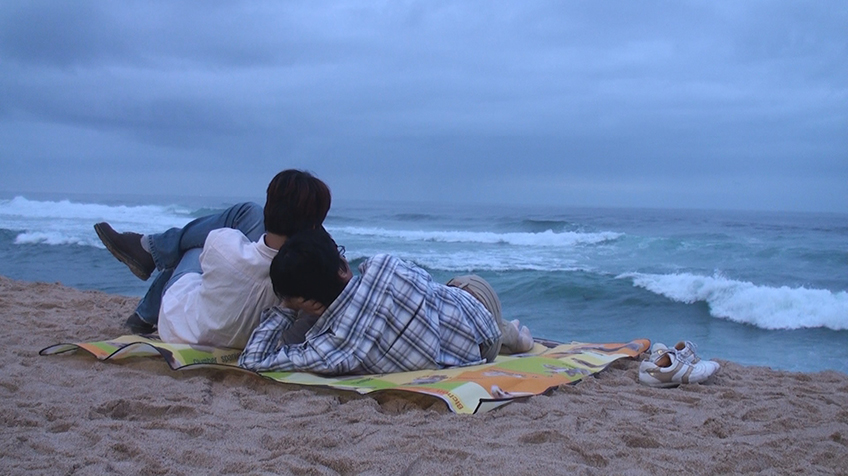
The main characters Gabriel and Du-yeol are lovers who live in a small roof top house. The love stor y bet ween the t wo who repeat a cycle of breaking up and get ting back together again become special when we realize they are both gay men infected with HI V/AIDS. T heir conflict occurs from the dif ferent at titudes they take in accepting their illness. For Gabriel who understands his infection was by accident and joins the fight for the rights of homosexuals and those infected with HI V/AIDS, and Du-yeol who is afraid to be discriminated for his illness he is terrified with, there just doesn’t seem room for seeing each other eye to eye. To make mat ters worse, deteriorating eyesight and health as well as the fear of the landlord finding out tears them fur ther apar t. Summer Days in Bloom is not a film that grandiosely claims for the rights of sexual minorities, especially those infected with HI V/AIDS. However, as the film follows the daily lives of the t wo men, it naturally exposes the level of discrimination they are faced with. Even without such obstacle, their daily and love lives are challenged by hardship. How much longer do they have to struggle this repetitive cycle of falling in love and breaking up? T he film poses this question to the audience. (HUH Kyoung) * Funded by Bucheon Media Center Fund for First Appearance
Director
-
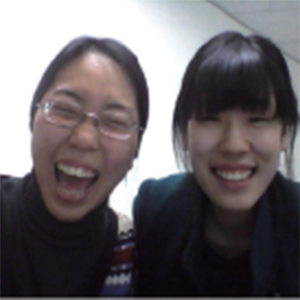 GO U-jung, ROH Eun-jiGo U-jung and Roh Eun-ji met in college and made a documentary about people living with HIV and their human rights, Over the Border. During production of this film, they got to know Gabriel and captured his life on camera, which led them to their rece nt documentary Summer Days in Bloom.
옥탑방 열기 Summer Days in Bloom (2012)
경계를 넘어 Over the Border (2008)
최우수 한국다큐멘터리상
Turn It Up to Eleven 2 : WILD DAYS
- Korea
- 2012
- 91min
- HD
- Color

Synopsis
In 20 09, filmmaker Baek Seung-hwa storms the documentar y films scene with Turn It Up to Eleven, a quirk y account on the bir th of Incheon-based live club and indie label, ‘Ruby Salon’ and the bands it is at tached to. Like the ‘Ruby Salon’ which was a breath of fresh air to the lagging Korean rock music scene, Turn It Up to Eleven also came as a pleasant shock to the Korean film industr y where rockumentaries were not so prevalent. In 2012, Baek returns with Turn It Up to Eleven 2: WILD DAYS to exclaim the need for a rock and roll star in this confounded countr y. The band Galax y E xpress who had appeared in the filmmaker’s previous film with another band, Tobacco Juice in which the filmmaker himself plays the drums returns to star in the sequel to explain the conception of the band in 20 0 6 as well as a detailed introduction of each member: the eccentric Jong-hyun who’s in charge of explosive vocals and guitar; the only-black- dressing bassist and vocalist Ju-hyun who dreams of the band going cosmic; and leopard-print-loving Hee-k won who became a drummer because he considered it the most basic. In the midst of earning the reputation of the ‘King of Korean rock,’ the film follows the three-week-long U.S. tour the band made in 2012. L acking any sense of objectivit y, the filmmaker’s brazenly whimsical narration combined with the appearance of the owner of the music label company, a designer and pop columnist who accompanied the band on their tour becomes an explosive outcome of candid humor. This is a tale of three rock and rolling men whose star t may be meager but end will be great. (CHUNG Woo-chung)
Director
-
 BAEK Seung-hwaBaek Seung-hwa studied animation at Kaywon School of Art & Design. He has built his career as both a storyboard writer and a drummer. Baek is Currently focusing on making music-related films and documentaries.
반드시 크게 들을 것 2: Wild Days Turn It up To Eleven 2: Wild Days (2012)
지각생들 Lateness (2012)
반드시 크게 들을 것 Turn It Up to Eleven (2009)
잘 자, 좋은 꿈 꿔! Good Night (2006)
청소년경쟁
최우수 청소년다큐멘터리상
Less Than 1%
- Korea
- 2012
- 54min
- HDV
- Color

Synopsis
No adolescents are free from competition for university places. Here are three teenagers who take a little different path. Chang-joon (aka. Mangchang), Beom (aka. Taepyong) and Seo-young (aka. Soul), the trio undertook the two-year trip, an innovative learning platform of alternative school called Road Schola. After finishing this travelling course, they are currently taking up the internship. Each of them plans a travel project such as youth group mountaineering expeditions in Nepal’s Annapurna Himalaya and weekend trip school. Experiences in project execution will serve them well in the future. The director follows these three interns including the director herself. Alternative school provides a different style of education for teenagers to lead them to learn and study. And it’s definitely not an easy course to follow. Once they were given the chance to go on a trip under the guidance of mentors. Now they develop tour itinerary, promote the travel packages and take children to Nepal and Vietnam. As much as the students wrestle with and assimilate their textbooks at school, the best learning on the road happens outside of the workbooks as well. In this society where school attendance is considered mandatory, teenagers take a different approach to school education. Why do we have to go to school? Is school education the only route to realize our dreams? Less Than 1% will hopefully give you some answers to these questions. (PARK Hye-mi)
Director
-
 HA Seo-youngFor 6 years, Ha Seo-young went to two alternative schools, Gandhi Village School and Road Schola. She was a chief editor of the school newsletter, RoadRock. While continued writing, Ha has been inundated with questions such as: “Aren’t you planning go to college?”, “What high school do you go to?” and “Aren’t you supposed to be in school?”. To clean up all these questions, she decided to make a documentary Less Than 1%.
대한민국 1% 미만 Less Than 1% (2012)
우수 청소년다큐멘터리상
I Want to Be a Nineteen
- Korea
- 2011
- 27min
- HDV
- Color
Synopsis
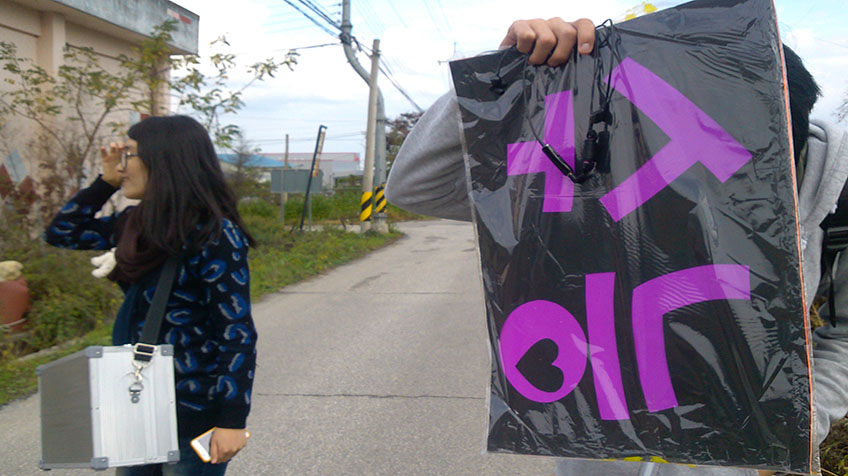
18 should be an age that makes the heart leap just by hearing it said, but it has long been replaced by the term ‘high school senior’ and lost its place. This is a time when so many young people give up their ‘today’ as collateral for ‘a better future’ and join in a competition that has no end in order to get better grades, academic backgrounds, and jobs than others. Complaints like ‘Do I really have to go to college?’ or ‘What is my dream?’ coming from immature kids being disregarded as evasion or daydreaming may be a normal result. ‘I’ wants to be 18 rather than just ‘a high school senior’ and is considered by her family and friends as a young, immature kid who doesn’t know anything about the world. Her parents who use their financial support as a weapon to order her to go to college no matter what and younger siblings who threaten her by citing cases around them and say she will regret it in order to make her change her mind are a force to be reckoned with. The tragedy of this tedious battle is that all this is based on the premise of happiness. Despite this fact, ‘I’ continues to talk of her dream. Watching her stand up to the formidable wall of reality and try slowly but surely to find her own life is enjoyable and even quite moving. She gets hit and broken, which will make her tougher, so it makes you curious to see how she will turn out when she is 28 or 38. This sad yet adorable film is not yet over. (KIM Ha-na)
Director
-
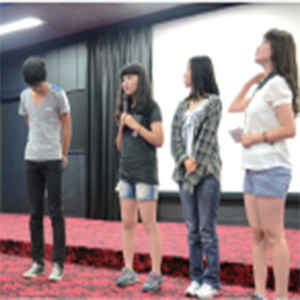 YU Min-ah, JUNG Min-su, KIM Su-min, KIM Seul-giThe quartet teamed up when they frequented the Gangneung Media Center. They joined the record team of the Jeongdongjin Independent Film Festival. Since then, they continued to work together in various visual projects. They founded a youth filmmaking club called ‘Rubicon Film’ and pursue their passion of filmmaking.
나는 열아홉이고 싶다 I Want to Be a Nineteen (2011)