
Synopsis
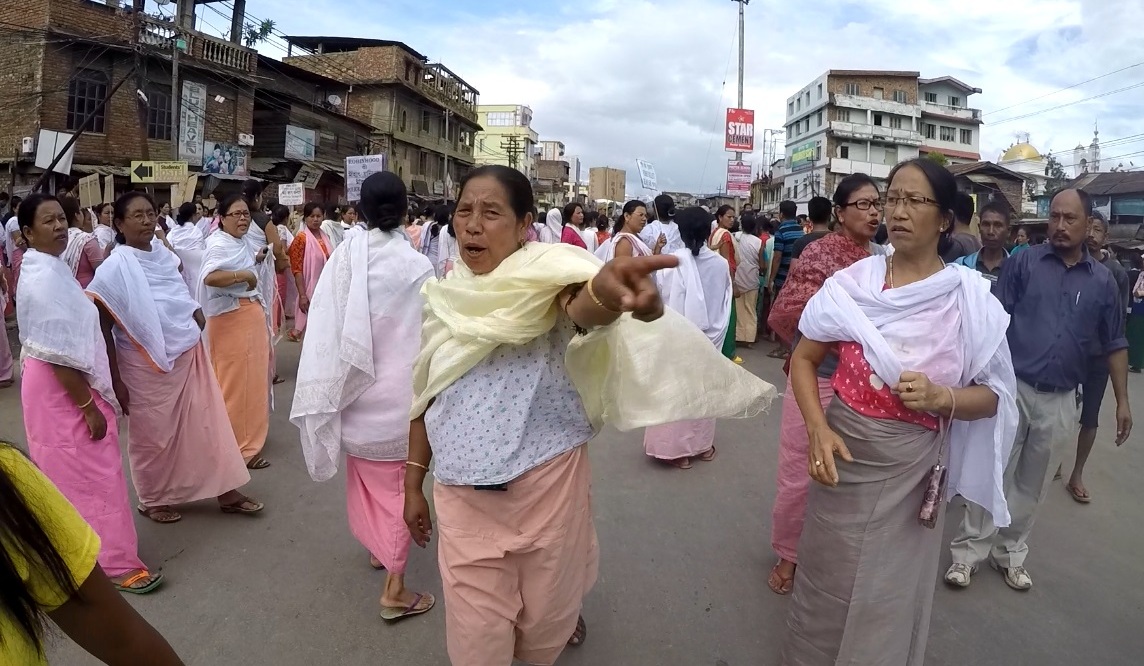
<Bloody Phanek> is a film on phanek, an exclusive attire similar to a sarong, which is worn by Manipuri women in northeastern India bordering Burma. It blends the personal and the political. The film aims to discover how women use phanek as a medium of protest, while it explores the inherent concept of impurity and how this attire challenges masculinity.
Director
-
Sonia NepramGun and a God (2012)
Phanek is an exclusive wear of Manipuri women. It is the mark of identity, which serves more than the purpose of simple clothing. This cloth carries an infinite symbolism revolving around both sexes. For instance, when people leave home, they carry a piece of their mothers’ phanek, using it as a token of protection and well-being. As it exists in other societies, this attire for women has a unique global appeal with its beauty; and similar to other cultures around the world, certain socio-cultural norms dictate how women wear a phanek.
Historical records show that strict codes of conduct were imposed on Manipuri women to adorn only the phanek with specific designs, colours and even the draping style, depending on occasions or occupations. Breaking these codes could lead the wearer to excommunication. Also the belief of ill-health and misfortune that could befall on the wearer is still prevalent today. In olden days, kings wore shirts made of phanek when they went to a battle with the belief that they would return victorious! Nothing is, however, mentioned about how it is impure and it can be used as a tool of protest.
Customarily, men are forbidden to touch a woman’s phanek, especially the used pieces. It is unimaginable for men to touch it. In popular culture, films and dramas portray how men would cringe when they are close to a phanek, regardless of the fact that it is literally an indispensable object throughout a lifetime.
In Manipur, women have always been at the forefront in any social and political issue. Phanek is significant again, which is evident both from the wearers as well as from the manners they use it for such symbolic use like blocking roads. However, back in their homes, they cannot keep their phanek together with their husbands’ clothes. In a conservative society, this is seemingly natural yet intriguing.
Review
Phanek is the ethnic wear commonly worn by women in Manipur area, India. In this film, this garment has double meanings. Firstly, the garment is a symbol of misogyny and female-gender segregation. As a garment tainted by women impurity, it should neither be touched by men, nor be washed along with men’s clothes. This is a typical misogynic culture in which female bodies are considered to be abject. Moreover, the Government of Manipur makes school girls’ wearing of Phanek compulsory in the name of preservation of traditional culture eaten away by Western one. In this manner, Phanek is used as a tool for male-centric nationalism. When the film reaches the middle of its duration, however, Phanek is transformed to a symbol of women’s empowerment. There are constant military tensions residing in Manipur area located in the border lines between Northeastern India and Miyanmar due to the opposition between government forces and the rebel army group—demanding the establishment of independent socialist government against government forces. Sexual assaults and rapes are almost institutionalized in this area, and safety for women is always threatened. Under this circumstance, women in Manipur area including young school girls, middle-aged women, etc. develops a ferocious resistance. It is quite touching to witness the scene when women encourage one another exclaiming “Girls, wrap the phanek!” in the midst of heated protest accusing violent acts conducted by soldiers. In the early part of the film, it seems to be a case study of misogynic practices on female bodies and femininity, but the film flows unexpectedly in the middle of the political situation of Northeastern India, and in the exquisite political protest. [Hwang Miyojo]
Credits
- Director, Producer Sonia Nepram
- Cinematographer, Editor Sandeep Soubam
- Music, Sound Sunil Loitongbam
Contribution & World Sale
- Contribution & World Sale Sonia Nepram
- E-Mail sonia.nepram@gmail.com