

Synopsis
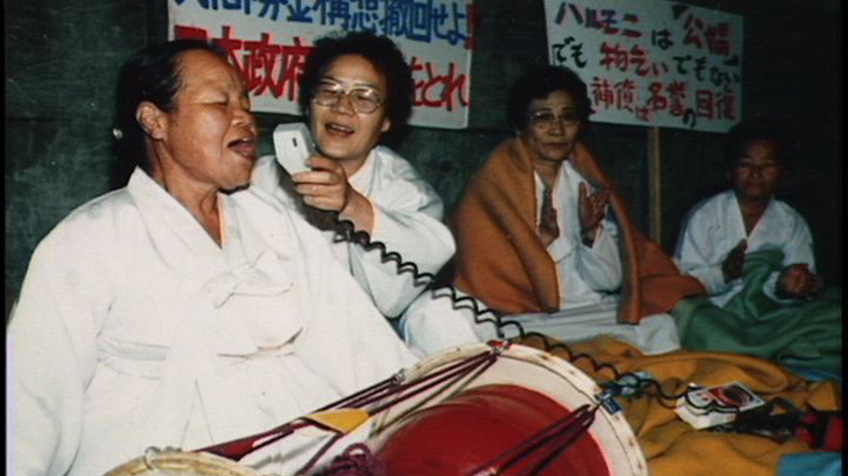
In May 1994, the fifteen victims ‘Comfort women’ visited Japan. Most of the victims have passed away, but Ms. Lee Oksun, who has always led the way with playing the janggu, live in the Sokli Mountain now. The precious footage, recording close to Ms. Lee Oksun who testifies her deep resentment for half a century, shares the message from a surviving victim.
Director
-
 Park Soo-nam또 하나의 히로시마: 아리랑의 노래 The Other Hiroshima: Korean A-bomb Victim Tell Their Story (1986)
아리랑의 노래: 오키나와에서의 증언 Song of Arirang – Voices from Okinawa (1991)
누치가후 Nuchigafu (2012)올해는 한일 국교 정상화 51년 해방 후 71년을 맞는다. 나는 1965년 한일협정에서 버림받아온 조선인의 원폭 피해자 실태조사를 시작하고 "위안부"로 명명된 제국의 성 노예에 대한 역사적 진실을 밝히는 다큐멘터를 제작해 왔다.이 작품은 그동안 오키나와 전장에 연행된 위안부의 실상과, 지금부터 20년 전에 일어나 함께 싸워온 위안부 피해자 할머니들의 기록이다. 200년 300년 살아서 일본 침략전쟁 책임을 고발하며 싸우겠다고 선언한 15명의 할머니들 대부분이 세상을 떠났다. 그녀들은 1994년부터 2년간 피맺힌 과거를 증언하며 일본 국가에 공식 사죄와 배상을 요구했다.
그것은 피해 당사자들의 명예 회복의 투쟁이었다. 2014년 나는 살아계신 이옥선 씨를 찾아가 다시 인터뷰 했다. 2015년 위안부 문제의 한일합의가 당사자를 배제한 채 강행되었다. 피해자들의 투쟁기록과 이옥선 씨의 증언을 통해 당사자 위안부 문제 해결의 본질을 함께 생각해보자.
Review
Park Su-nam, a second generation Korean Japanese in her 80s, has been filming for over 20 years the victims of Japanese Army’s ‘Comfort Women’. Three different time-lines intersect with each other in the film. It opens with a scene where the film-maker is reunited at Mt. Songni with Lee Ok-seon who is a victim. And then the film goes back to 1989 and conveys dialogues with Bae Bong-gi who had testified about her experience as a ‘Comfort Woman’ 16 years before Kim Hak-sun, for the first time in Korea, openly testified about her life as a ‘Comfort Woman.’ And the film shows the activities of 15 victims who went over to Japan and demanded official apology and reparations by the Japanese government. The film covers a span of almost 30 years, from the late-1980s when the issue of Japanese Army’s ‘Comfort Women’ began to be raised in Korean Japanese community and in Korean society, to the mid-1990s when the victims put up a struggle directly against the Japanese government, and to the year 2014 when the film-maker and the heroine respectively in their 80s are reunited, and it makes us reflect on what we have achieved for the period. The film-maker, having the national identity of Korean Japanese, frames with his own point of view the issue of ‘Comfort Women’ which is complicated with the matters of nationality, war, sex slavery, women and patriarchy. [Jeong Min-ah]
Credits
- Director Park Soo-nam
- Producer, Editor Park Ma-eui
- Cinematographer Koshiro Otsu, Han Jong-gu
Contribution / World Sales
- Contribution / World Sales Arirang Production
- E-mail mai.park@gmail.com